

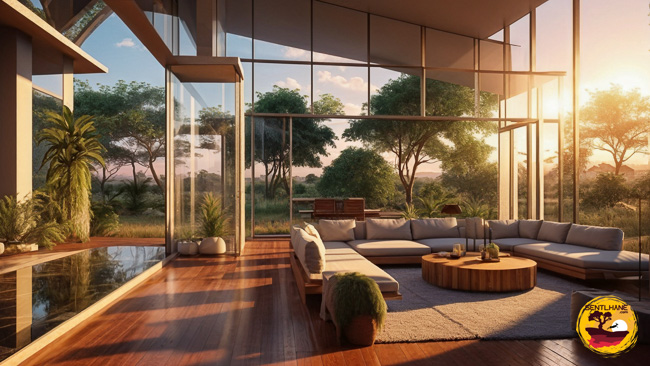
The morning in Sentlhane begins with a deliberate quiet, a kind of pause that belongs to places where light and air are not background scenery but working parts of daily life. Across a line of freehold plots, verandas hold the last of the night’s cool, and windows set high under deep eaves admit a breeze that moves like a slow conversation. This is not a brochure trick, since the houses at Eden Hills are being planned to let the landscape do real work, and to prove that sustainability in Botswana can feel like comfort first and technology second.
Eco living succeeds when design earns its keep before a single appliance is switched on. Orientation becomes the first tool, because a house that faces prevailing wind and protects its glass with shade will run cooler with less effort, while a plan that gathers rooms around an outdoor living space will let light travel without creating glare. Builders here talk about verandas as if they were mechanical equipment, and they are right to do so, since a broad roof that tempers noon sun can lower temperature and mood in equal measure. In a climate that rewards shade and cross ventilation, good siting is not a stylistic flourish, it is performance engineering made from air and patience.
Materials, chosen with care, extend the logic. Honest plaster, local stone, and dense timber hold their character in strong sun, and they learn to age in a way that looks better rather than worse with time. Floors that carry thermal mass flatten the day’s swings, while pale exterior tones reject heat that darker paints would soak up. When these choices meet careful detailing, such as shaded glazing, louvered vents, and insect screens that do not strangle airflow, a modest plan begins to feel surprisingly generous. Owners who thought they needed more square meters often discover that they needed more shade and a smarter section.
Water, which is the quiet wealth of the bush, is treated as a cycle instead of a commodity to be thrown away. Roofs are drawn with collection in mind, storages are placed where gravity can assist rather than fight, and gardens shift toward indigenous planting that prefers seasonal rain to constant irrigation. Paths keep runoff on the land for as long as possible, and permeable surfaces reduce the quick rush that starves the soil. In a reserve neighborhood, this is not only a bill to be lowered, it is habitat respected and songbirds invited, which changes a morning far more than a glossy kitchen ever could.
Power follows a similar path. Photovoltaics on a sunlit roof make sense because the sky will show up more reliably than a schedule, and battery storage turns that sunlight into evening light in a way that feels almost ordinary once the rhythm is set. Owners still choose their level of technology, since preferences and budgets differ, but the guiding idea is clear. The house should be a partner, not a dependent, and the grid should be a safety net rather than a crutch. In a place like Sentlhane, where nights are dark enough to remember stars, dark sky lighting with warm temperatures preserves the heavens, protects wildlife movement, and turns an ordinary walk into something quietly theatrical.
Stewardship is not only about the building, it is also about the land that holds it. Eden Hills threads homes along green corridors that lead into a central conservation core, so small decisions at the plot level add up to real effects at the neighborhood scale. A fence that guides rather than blocks keeps movement predictable and gentle. A garden that favors indigenous grasses and shrubs supports insects, which support birds, which support the larger pattern of the reserve. Even the way people live shifts, because when you hear francolins at first light and zebra on certain evenings, a weekend feels like a weekend without driving anywhere.
Sustainability rarely thrives under lectures, it thrives under routines that feel good enough to keep. Owners here set out water for bricks and brooms rather than for hoses, sweep verandas in the early cool instead of hosing them at noon, and learn which windows to open as the ridge wind changes through the day. They seal where dust can creep, they check the angle of shade as the year turns, and they discover that maintenance is light when design has done its job. The reward is a home that stays calm through seasons, and a bill that behaves like a line rather than a set of spikes.
There is also a human dividend that led many families here in the first place. Eco living in a wildlife estate is not a denial, it is a permission slip. Children spend afternoons under trees instead of under screens. Cooking moves outdoors more often, and meals linger because the air is kind and the light is honest. Friends stay later because roads are quiet and the path back to the house is marked by familiar shadows. A sustainable home is not a sermon, it is a place that conducts a life worth repeating.
Stand on a plot in Sentlhane in the hour before sunset and imagine the house that will welcome you back from a short drive into Gaborone. Give it a roof that throws a deep line of shade, give it windows that talk to the wind, and give it a garden that knows the names of the birds that visit. If that picture feels like a promise kept, you have already chosen the right direction. The rest is detail and patient work, which are the two things that good houses always ask for.
Kicker: Eco living here is not a trend, it is a habit, a measured house on generous land that turns ordinary days into a quiet kind of luxury.